
Should Advertising agencies be Embracing AI?

Should Advertising agencies be embracing AI?

The short answer is yes.


However understanding the limitations and the continued need for creative minds is key. AI offers transformative capabilities that can enhance efficiency, creativity, and effectiveness in campaigns. Understanding the best way to utilize AI without relying too heavily is the key to enhancing your services without becoming a robot. 


AI adoption offers:

1. Data-Driven Insights

AI analyzes vast amounts of consumer data to identify trends, preferences, and behaviors. This enables agencies to create highly targeted campaigns that resonate with specific audiences.

2. Personalization at Scale

AI enables hyper-personalized advertising by delivering tailored messages to individuals based on their unique characteristics, behaviors, and preferences, increasing engagement and conversion rates.

3. Cost Efficiency

Automating repetitive tasks, such as keyword research, ad placement, and performance tracking, reduces operational costs and allows agencies to allocate resources toward strategic and creative tasks.

4. Real-Time Optimization

AI can monitor campaign performance in real-time and make instant adjustments to improve outcomes, such as reallocating budgets, optimizing creatives, or adjusting targeting parameters.

5. Creative Enhancements

Generative AI tools assist in developing ad copy, visuals, and videos, providing creative teams with inspiration and speeding up the production process while maintaining quality.

6. Predictive Analytics

AI predicts future trends and customer behaviors, allowing agencies to proactively design campaigns that align with emerging opportunities and market shifts.

7. Enhanced Customer Experience

Chatbots and AI-driven customer service tools improve interaction quality and speed, providing a seamless and engaging experience for users.

8. Competitiveness

As more agencies adopt AI, those that don't risk falling behind. AI ensures that agencies remain competitive in delivering innovative and effective solutions to clients.

9. Global Reach and Localization

AI supports multilingual and multicultural campaigns by automatically translating and adapting content to different cultural contexts, expanding the reach of campaigns.

10. Sustainability

By optimizing resources and reducing waste in digital advertising, AI contributes to more sustainable marketing practices.

Incorporating AI helps advertising agencies stay ahead in a rapidly evolving industry, fostering innovation, improving ROI for clients, and creating more meaningful connections with audiences.


While AI offers significant advantages for advertising agencies, it also comes with limitations and challenges that need to be addressed to ensure effective use. Here are the key limitations of relying on AI in advertising:


1. Lack of Human Creativity

AI excels at pattern recognition and optimization but struggles to replicate human creativity, emotional intelligence, and originality. Ads that require deep storytelling or cultural nuance may fall short if solely reliant on AI.

2. Dependence on Data Quality

AI performance depends on the quality and quantity of the data it processes. Poor, biased, or incomplete data can lead to inaccurate predictions, ineffective targeting, or even discriminatory ad campaigns.

3. Over-Personalization Risks

Excessive reliance on AI for personalization can lead to "creepy" user experiences, where consumers feel uncomfortable or intruded upon due to overly precise targeting.

4. Ethical and Privacy Concerns

AI-driven advertising often involves extensive data collection and tracking, raising concerns about consumer privacy and compliance with regulations like GDPR and CCPA. Agencies must navigate these complexities carefully.

5. High Initial Investment

Implementing AI tools and technologies can be expensive. Small or mid-sized agencies might struggle with the upfront costs and ongoing expenses for maintaining AI systems.

6. Algorithmic Bias

AI systems can unintentionally perpetuate or amplify biases present in training data, leading to unfair targeting or exclusion of certain groups.

7. Complexity and Expertise Requirements

AI systems require specialized knowledge for setup, interpretation, and optimization. Agencies may need to invest in hiring or training experts, which can be a barrier for smaller organizations.

8. Limited Understanding of Context

AI lacks true contextual understanding and may misinterpret cultural, social, or situational nuances, leading to tone-deaf or inappropriate content.

9. Over-Reliance on Automation

Excessive reliance on AI-driven automation might reduce human oversight, increasing the risk of errors or missed opportunities that require a human touch.

10. Job Displacement Concerns

Adopting AI could lead to fears of job displacement among creative and analytical teams, potentially creating resistance to its integration within the agency.

11. Lack of Emotional Connection

AI-generated ads may lack the emotional depth or authenticity that comes from human creators, potentially reducing their impact on audiences.

12. Difficulty in Measuring ROI

Although AI can optimize campaigns, demonstrating a clear return on investment (ROI) directly attributable to AI-driven strategies can sometimes be challenging, especially in complex campaigns with many variables.

13. Risk of Homogenization

AI often relies on past successes to inform its decisions, which can lead to repetitive or formulaic content that lacks innovation or differentiation.

14. Security and Dependence Risks

Agencies relying heavily on AI systems could face cybersecurity risks, such as data breaches, and might become overly dependent on specific AI platforms or vendors.


Addressing These Limitations

To overcome these challenges, agencies should adopt a balanced approach, combining AI’s strengths with human expertise. Regular monitoring, ethical guidelines, diverse teams, and transparency in AI use are essential for minimizing risks and maximizing the benefits of AI-driven advertising.


August 14, 2026
Website accessibility has been a conversation for years, but recent changes to federal accessibility requirements are putting an even bigger spotlight on how websites work for people with disabilities. And if your website hasn’t been reviewed for accessibility recently, now is a good time to take another look. At River City Advertising, we have the tools to add accessibility-focused features that are easier for everyone to use. What Changed With ADA Website Accessibility? In 2024, the U.S. Department of Justice issued a new rule under Title II of the Americans with Disabilities Act establishing a specific technical accessibility standard for websites and mobile apps provided by state and local governments. That standard is WCAG 2.1 Level AA —a widely recognized set of Web Content Accessibility Guidelines designed to make digital content more accessible to people with visual, auditory, physical, cognitive and other disabilities. In 2026, the DOJ extended the deadlines for these public entities: April 26, 2027: State and local government entities with populations of 50,000 or more April 26, 2028: Smaller public entities and special district governments While these particular deadlines apply to state and local governments, the changes reinforce something that affects organizations of all kinds: website accessibility is becoming increasingly important. Businesses should also remember that accessibility obligations can vary depending on the type of organization, services provided and applicable federal, state and local laws. What Does an Accessible Website Actually Mean? Accessibility isn't simply adding a button to your website. An accessible website is designed so people with disabilities can navigate, understand and interact with its content—including visitors who use screen readers, keyboard navigation or other assistive technologies. Some of the elements that can affect accessibility include: Alternative text for meaningful images Appropriate color contrast between text and backgrounds Clear heading structures Keyboard-friendly navigation Properly labeled buttons, links and form fields Readable text and logical page layouts Accessible forms Captions or alternatives for multimedia content Correct website language settings Content that works effectively with screen readers Many of these features also happen to make a website easier to use for everyone , not only visitors with disabilities. How Our Platform Helps Us Build More Accessible Websites At River City Advertising accessibility isn't treated as an afterthought. Our platform includes built-in functionality that can help developers create more accessible websites, including support for alternative text, keyboard navigation and automatic website language definition. Our platform also integrates with accessibility solutions such as UserWay and AudioEye for businesses and organizations that want additional accessibility tools, monitoring and remediation capabilities. However, there is an important distinction: No website platform, plugin or accessibility widget can automatically guarantee that a website is 100% ADA compliant. Accessibility depends on the platform and how the website is designed, written, maintained and updated. For example, adding an accessibility tool doesn't fix a poorly structured page, unclear link text, an inaccessible third-party application or every issue created when new content is added. That is why accessibility should be viewed as an ongoing website-management practice rather than a one-time checkbox. Why Businesses Should Pay Attention Now Even if the newest Title II deadlines don't apply directly to your business, there are several reasons to make website accessibility a priority. Reach more people. An accessible website makes it easier for more potential customers to interact with your business online. Create a better user experience. Clear navigation, readable content, properly labeled forms and thoughtful page structure benefit everyone. Support your SEO efforts. Several accessibility best practices—such as descriptive image text, organized headings and well-structured content—can also help search engines better understand your website. Reduce unnecessary risk. Digital accessibility continues to be an important legal and regulatory issue. Proactively improving accessibility is much better than waiting until someone identifies a problem. Prepare your website for the future. Accessibility standards and expectations continue to evolve. Building accessibility into your website now makes it easier to adapt as requirements change. Accessibility Isn't "Set It and Forget It" This may be the most important takeaway. Your website can become less accessible over time as new pages, images, videos, forms, integrations and other content are added. That's why website accessibility should be part of ongoing website management. At River City Advertising, we can help businesses evaluate their current websites, identify accessibility concerns and determine what tools or updates may make sense. Is It Time for an Accessibility Check? If you're unsure how your current website measures up, we can help you take a closer look. Contact River City Advertising to talk about your website, accessibility options and how we can help make your online presence easier for more people to use.  This article is provided for general informational purposes and is not legal advice. ADA and digital accessibility requirements can vary depending on your organization and jurisdiction. Businesses with questions about their specific legal obligations should consult qualified legal counsel.
Silhouetted profile with glowing tech symbols and data overlays against a light background
By Jessica Ellett June 17, 2026
Artificial intelligence has changed the way businesses create content, brainstorm ideas, and tackle day-to-day marketing tasks.
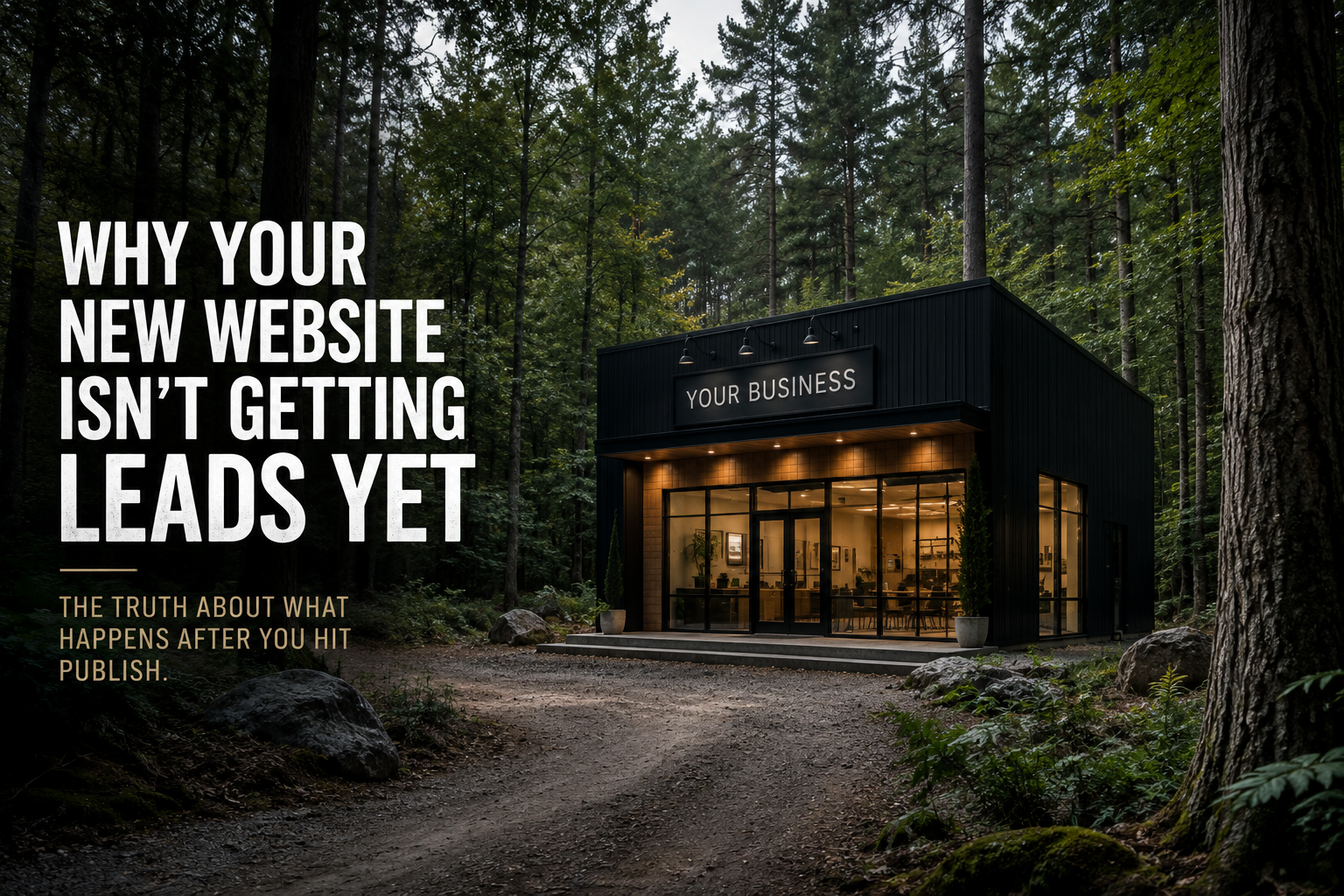
Website mockup: black cabin office in a forest with bold text, “Why your new website isn’t getting leads yet”
By Justin Ellett May 18, 2026
You launched a brand-new website.
An isometric map shows a small suburban neighborhood with several houses, roads, and a central roundabout with a pin.
By Jessica Ellett March 31, 2026
Tiny Roundabouts & Bad Branding: Why Ignoring the Basics Costs You More in the End
Musician playing acoustic guitar on a warmly lit stage with blurred band members in the background
By Jessica Ellett March 16, 2026
For musicians, a website isn’t just a place to store information. It’s a place to create an experience.
Two people sitting on a park bench, using a laptop and reading a tablet.
By Jessica Ellett February 26, 2026
(And the People Calling You Are Probably Women.)
Hands collaborating over colorful notes and sketches on a table during a planning meeting
By Jessica Ellett November 6, 2025
Branding Mistakes That Quietly Cost Small Businesses Thousands
Black-and-white speech icon with a face silhouette and sound waves in a circle
By Jessica Ellett August 22, 2025
The Tiny Words That Make a Big Difference in How You’re Heard
Billboard reading “TRENDS 2025” against a blue sky with clouds
By Jessica Ellett July 8, 2025
Branding Heat Check: What’s Sizzling This Summer
Two coworkers shaking hands in a bright office with colleagues smiling in the background
By Jessica Ellett March 6, 2025
Why Getting Back to People Matters