
A Website Is Not Marketing (And Why That Matters)
You launched a brand-new website.

 It looks professional. The design is clean. The photos are sharp. The messaging feels solid.


Then a few days go by…


And you start wondering:


“Why aren’t we getting leads yet?”


Here’s the reality:


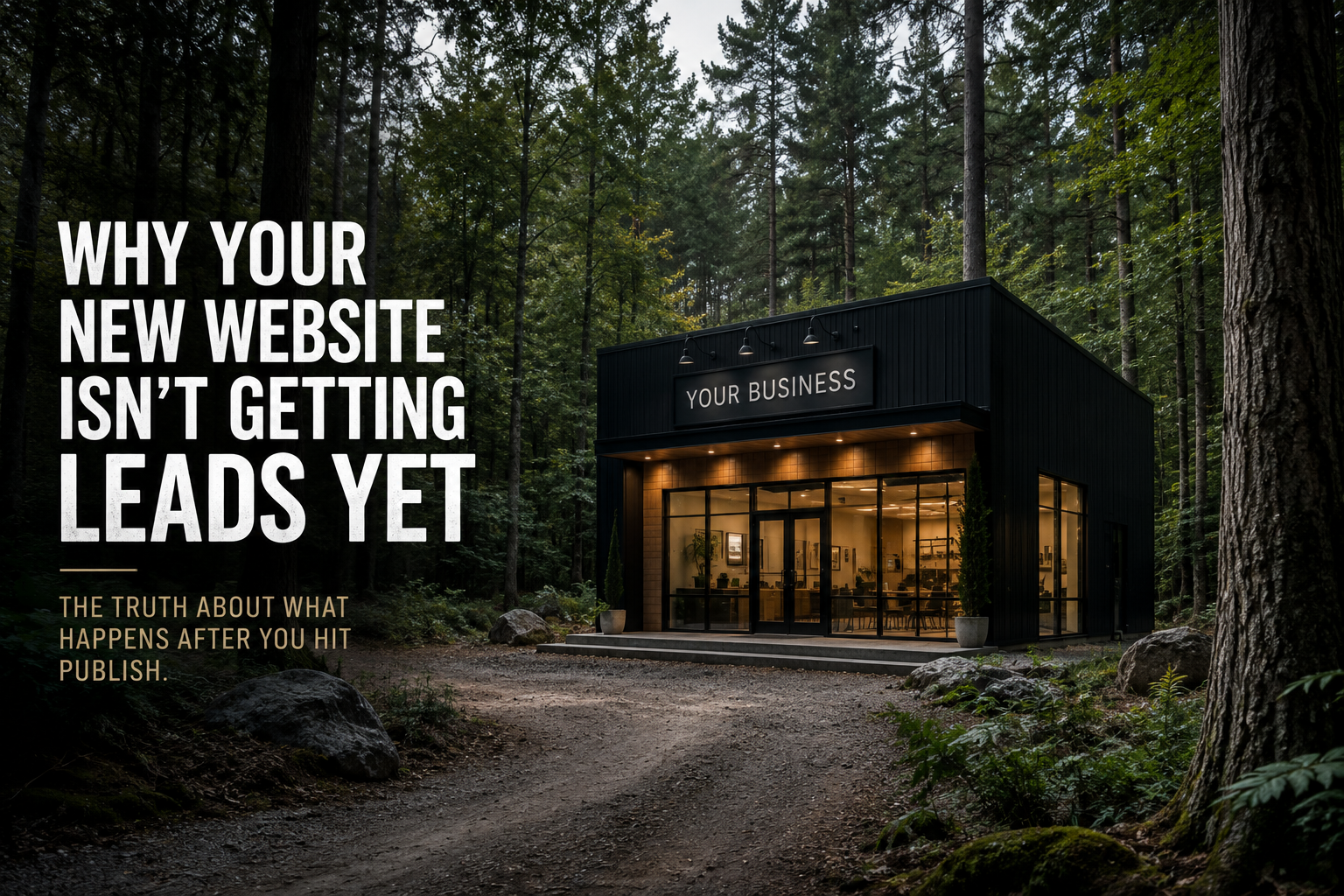
Launching a website without marketing is kind of like opening a beautiful store in the middle of the woods and expecting customers to somehow find it.


People can’t do business with you if they don’t know you exist.


Your website isn’t the finish line — it’s the foundation.


One of the biggest misconceptions we see is the belief that a new website automatically creates traffic, phone calls, and sales.


In reality, websites perform best when they’re backed by ongoing visibility, strategy, and optimization.


Here are some of the biggest reasons businesses don’t immediately see leads after launching a new website:


1. Nobody Knows Your Website Exists Yet

This is by far the most common issue.


A new website has no authority with search engines yet. Google doesn’t instantly push brand-new websites to the top of search results. It takes time, content, backlinks, optimization, and consistency for search engines to begin trusting and promoting your site.


Without active marketing efforts like:


  • SEO
  • Google Ads
  • Social media campaigns
  • Email marketing
  • Video content
  • Local search optimization


…your website is basically sitting online waiting to be discovered.


Websites need traffic generation after launch — not just before launch.


2. A Website Is Not a “Set It and Forget It” Tool

A lot of businesses still treat websites like printed brochures.

But the internet changes constantly.


Search algorithms evolve. Competitors update their content. Consumer behavior shifts. AI search tools are changing how people find businesses online.


If your website stays exactly the same month after month, it can slowly lose visibility and relevance.


The websites that perform best are living marketing tools that require:

  • Fresh content
  • SEO updates
  • Performance improvements
  • Landing page testing
  • Blog publishing
  • Updated photos and videos
  • New offers and calls-to-action


A stagnant website rarely becomes a lead-generating machine.


3. Traffic Doesn’t Automatically Mean Conversions

Sometimes businesses are getting website traffic — but still not getting leads.


That’s because traffic alone isn’t enough.


Your website also has to:

  • Build trust quickly
  • Clearly explain what you do
  • Show why you’re different
  • Guide visitors toward action
  • Make contacting you easy

If people land on your site and feel confused, overwhelmed, or uncertain, they leave.


4. Your Messaging May Sound Like Everyone Else

A lot of websites say the same things:

“We provide quality service.”
“We care about our customers.”
“We are committed to excellence.”


That kind of language doesn’t separate your business from competitors.


People decide within seconds whether your business feels relevant to them. Your website should immediately answer:

  • What do you do?
  • Who do you help?
  • Why should someone choose you?
  • What should they do next?


Clear messaging converts better than vague marketing language every time.


5. Your Website Might Not Work Well on Mobile

Most website traffic today happens on phones.


If your website:


  • Loads slowly
  • Has tiny text
  • Feels cluttered
  • Is difficult to navigate
  • Has forms that are annoying to fill out


…people leave quickly.


A website can look amazing on desktop and still perform terribly on mobile — and that absolutely impacts lead generation.


6. There Are No Trust Signals

People are skeptical online.


Before someone contacts a company, they want reassurance that the business is legitimate and trustworthy.


Strong websites include things like:

  • Reviews
  • Testimonials
  • Case studies
  • Before-and-after examples
  • Real photos
  • Certifications
  • Client logos
  • Clear contact information


Without trust signals, people hesitate.


And hesitation usually means they leave.


7. Your Calls-to-Action Aren’t Strong Enough

A surprising number of websites never clearly tell visitors what to do next.


“Learn More” usually isn’t enough.


People respond better to direct actions like:


  • Schedule a Consultation
  • Request a Free Quote
  • Book an Appointment
  • Call Now
  • Get a Marketing Audit


Your website should guide visitors — not make them figure it out themselves.


8. SEO Takes Time

This is one of the hardest things for businesses to hear:

SEO is not instant.


Even with a well-built website, it often takes months of:

  • Content creation
  • Keyword optimization
  • Technical improvements
  • Link building
  • Local SEO work
  • User engagement


…before strong organic traffic starts building.


The businesses that win online are usually the ones that stay consistent the longest.


9. Your Website Was Designed to Look Good — Not Convert

There’s a big difference between a beautiful website and a strategic website.


A lot of websites are built like digital brochures instead of lead-generation systems.


A high-performing website should intentionally guide visitors through a process:

  • Grab attention
  • Build trust
  • Solve a problem
  • Create urgency
  • Make action easy


Design matters. But strategy matters more.


The Bottom Line

A website isn’t magic.

It’s a tool.


And like any tool, the results depend on how it’s used, maintained, promoted, and improved over time.


The businesses consistently generating leads online are usually doing multiple things at once:

  • Running traffic campaigns
  • Improving SEO
  • Publishing fresh content
  • Updating their website regularly
  • Monitoring analytics
  • Testing conversion strategies
  • Building trust online


At River City Advertising, we help businesses in Richmond and beyond turn websites into active marketing systems — not just online placeholders.


Because launching the website is only the beginning.


Share this post...

Four serious-looking people stand against a gray backdrop, wearing muted and bright sweaters.
By Jessica Ellett • October 22, 2026
Sometimes the best thing you can do for your brand is step out of the spotlight. We've all seen them. Those local commercials where a business owner stands awkwardly in front of the camera, stiff as a board, trying desperately to remember their lines while looking like they'd rather be literally anywhere else. And here's the thing. Their business might be AMAZING. They might have incredible products, beautiful projects, a talented team, and years of experience. The commercial might even feature fantastic footage showcasing all of that. But nobody's paying attention to it. Why? Because we're all watching the owner struggle through their 15 seconds of fame. Your Commercial Should Sell Your Business, Not Your Discomfort There's a reason professional actors, voiceover artists, and on-camera personalities exist. Being comfortable in front of a camera is a skill, and it's not one that comes naturally to everyone. And that's perfectly fine! You can be an incredible contractor, someone who designs custom closets, restaurant owner, attorney, or entrepreneur without being a great television personality. The problem starts when someone decides that because they're the face of the business, they also need to be the face of the advertising. Suddenly, what could have been a beautiful commercial showcasing stunning renovation projects, delicious food, or impressive work becomes a painfully awkward presentation. The audience isn't thinking about hiring you. They're thinking, "Wow, that guy really doesn't want to be on camera." And just like that, you've lost them. Great Footage Can't Save a Bad On-Camera Performance Imagine a roofing company with incredible drone footage of completed projects, crews hard at work, and gorgeous before-and-after transformations. That's fantastic material for a commercial! Now imagine cutting back every few seconds to the owner standing uncomfortably in front of the camera, speaking in a monotone voice, awkwardly delivering lines that sound memorized rather than natural. What do you remember when the commercial ends? Probably not the roofs. You remember the awkward guy. And that's a huge missed opportunity. The whole point of advertising is to make people remember your business for the RIGHT reasons. Authenticity Is Great. Forced Authenticity Isn't. Now, don't get us wrong. We LOVE featuring business owners in their advertising when it works. Some owners are naturally charismatic. They're funny, passionate, engaging, and genuinely comfortable talking about what they do. Those people can be advertising gold. And you don't have to look like a polished television host to connect with an audience. Sometimes a little imperfection makes someone more relatable. But there's a big difference between being authentic and being visibly uncomfortable. If someone looks terrified, sounds robotic, or delivers every sentence like they're reading a hostage statement, putting them on camera isn't helping their business. It's distracting from it. There Are Better Ways to Tell Your Story If you're not comfortable in front of the camera, that doesn't mean your personality or expertise can't be part of your advertising. There are plenty of other ways to make a commercial feel personal: Use a professional voiceover. Let the visuals showcase your work while an experienced voice delivers your message. Show your team in action. Real footage of people doing what they do best can be far more compelling than someone standing and talking. Try an interview format . Some owners are fantastic when they're having a natural conversation instead of memorizing a script. Let your customers do the talking. A genuine testimonial can be incredibly powerful. Focus on the work itself. Sometimes the best commercial is simply beautiful footage, great music, and a strong message. And if you really want to be in your commercial? Work with a production team that knows how to make you comfortable and bring out your personality. The goal isn't to make everyone look like a professional actor. It's to make sure the message connects. Don't Let Your Ego Get in the Way of Your Advertising This might be the hardest part. We get it. You've built the business. You've poured your time, money, and energy into making it successful. You're proud of what you've created, and you want people to know who's behind it. You absolutely should be proud! But owning the business doesn't automatically make you the best spokesperson for it. A good marketing team should be willing to tell you that. Not because they don't believe in you, but because they do believe in your business and want the advertising to be as effective as possible. Sometimes that means putting you front and center. And sometimes that means letting your work speak for itself . The Bottom Line You have a limited amount of time to grab someone's attention in a commercial. Don't waste those precious seconds making viewers uncomfortable right along with you. If you've got beautiful footage, great projects, fantastic products, or an incredible team, SHOW THEM OFF! Make people remember what makes your business special. Not how awkward you looked telling them about it. At River City Advertising, we believe great marketing isn't about putting someone in front of a camera just because they own the company. It's about finding the most effective way to tell their story. And sometimes, the smartest marketing decision is knowing when to stay behind the camera. Ready to create advertising that puts your business in its best light? Let’s talk about your next commercial.
October 19, 2026
Blue Sky Fund is a youth development non-profit that provides transformational experiences for Richmond area youth through outdoor education.
Black italic text reading “Just Do It” on a white background
September 18, 2026
Your tagline may be more important than your logo
A puppy wearing a red superhero cape casts a shadow against a wall that depicts a person holding a dog leash.
August 26, 2026
Leashes of Valor provides highly-trained service dogs at no cost to wounded and disabled post-9/11 veterans.
A hot air balloon is flying over a sign that says credibility
August 26, 2026
What is more important: a lead list or credibility?
Accessibility buttons on a wall panel: CC, audio, visual, touch, magnifier, and wheelchair icons
August 14, 2026
Understand ADA website accessibility for 2026. Contact River City Advertising for expert guidance on compliance & digital accessibility.
Silhouetted profile with glowing tech symbols and data overlays against a light background
By Jessica Ellett • June 17, 2026
Artificial intelligence has changed the way businesses create content, brainstorm ideas, and tackle day-to-day marketing tasks.
An isometric map shows a small suburban neighborhood with several houses, roads, and a central roundabout with a pin.
By Jessica Ellett • March 31, 2026
Tiny Roundabouts & Bad Branding: Why Ignoring the Basics Costs You More in the End
Musician playing acoustic guitar on a warmly lit stage with blurred band members in the background
By Jessica Ellett • March 16, 2026
For musicians, a website isn’t just a place to store information. It’s a place to create an experience.
Two people sitting on a park bench, using a laptop and reading a tablet.
By Jessica Ellett • February 26, 2026
(And the People Calling You Are Probably Women.)